


From Legal Effort to Legal Impact
How Contract Management Supports a More Effective Legal Operating Model
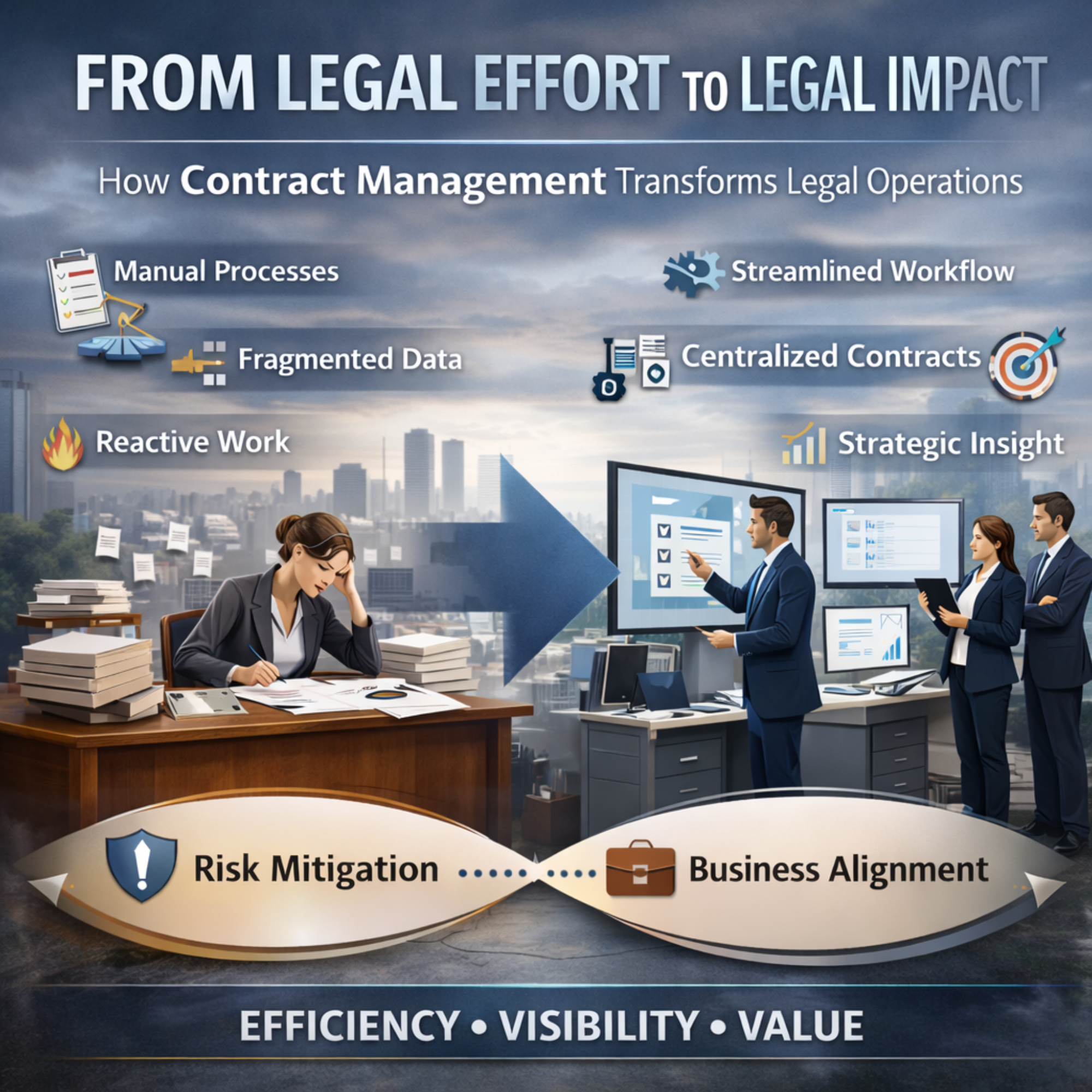
Legal accountability now extends beyond compliance into performance and visibility. Legal teams must not only manage risk but demonstrate how their work supports execution and strategic objectives. Contracts sit at the centre of this responsibility, yet in many organisations they continue to be managed through fragmented processes and manual coordination rather than structured systems.
The consequence is predictable. Legal work gets done, but its impact is not always easy to explain or connect to broader business priorities.
Contract management technology is often positioned as a solution to this problem. But its real value is not simply efficiency. It lies in helping legal teams work with greater consistency, visibility, and clarity, without adding unnecessary operational complexity.
The challenge is not a lack of tools
Most legal teams already use document management systems, e-signature platforms, and shared repositories. Despite this, a number of challenges persist:
- Legal effort is difficult to link clearly to business priorities
- Contract risk is addressed reactively rather than systematically
- Context around approvals, authority, and execution is dispersed
- Productivity depends heavily on individual experience
These challenges are rarely caused by a lack of effort or expertise. More often, they stem from the absence of structure that allows legal work to be understood, repeated, and measured consistently.
How business leaders evaluate value
Business leaders typically think in terms of priorities, initiatives, and outcomes. They ask questions such as:
- Which areas of the business are strategic over the next few years?
- Where are we investing time and capital?
- What risks could undermine those objectives?
- How effectively do support functions enable execution?
Legal teams add the most visible value when their work can be described in similar terms. Achieving this consistently, however, is difficult when contracts and related activity are managed in ways that obscure context and decision-making.
This is where contract management platforms can play a supporting role, by providing structure rather than replacing legal judgement.
What effective contract management enables
At a practical level, effective contract management is less about automation and more about making legal work easier to navigate and understand.
When implemented thoughtfully, it can help ensure that:
- contracts are easier to locate, review, and report on
- approvals and authority are clearer and more consistent
- execution records are easier to retrieve when needed
- legal teams spend less time coordinating process and more time with strategic initiatives
These outcomes are achieved through repeatable processes that reduce reliance on informal practices and individual memory.
How Co-Flo supports this approach
Co‑Flo is positioned as a platform that helps teams manage work, matters, and related information in a more structured way. In the context of contracts, its role is to support consistency, visibility, and traceability across the lifecycle of legal work.
Supporting business context
Through configurable matter structures, metadata, and reporting, Co-Flo can help legal teams organize contracts in ways that reflect business units, initiatives, and risk categories. This makes it easier to explain what work is being done and why, using language that resonates beyond the legal function.
Supporting consistent processes
Many contractual issues arise not from drafting errors, but from inconsistent processes. Co-Flo can be configured to support standardized intake, defined workflows, and approval paths, helping legal teams apply agreed processes more consistently across matters.
Supporting traceability and record-keeping
When contracts are questioned, legal teams are often required to reconstruct how an agreement was approved and executed. By acting as a central workspace for contract-related activity, Co-Flo can make it easier to identify final versions, understand approval context, and retrieve supporting information.
When combined with an appropriate e-signature solution, this can help support a more defensible execution record, provided audit artefacts are retained.
Understanding the limits of technology
It is important to be clear about what contract management platforms do not do.
They:
- do not determine whether a document may be signed electronically under law
- do not replace legal analysis or due diligence activities
- do not guarantee enforceability
Those responsibilities remain with legal teams and their advisors. Technology provides structure and support, not legal conclusions.
A practical takeaway for legal professionals
For both in-house legal teams and law firms, the value of contract management technology lies in reducing operational friction so that legal expertise can be applied more effectively.
When legal work is easier to explain, easier to evidence, and easier to manage consistently, its contribution to the organization becomes clearer. Productivity gains follow not from working harder, but from working within systems that support clarity and control.
That is the practical shift contract management enables: less effort spent on coordination, and more effort focused on judgement and impact.


